
Diabetes in Africa
The number of people living with diabetes rose from 200 million in 1990 to 830 million in 2022. Prevalence has been rising more rapidly in low- and middle-income countries than in high-income countries.
The number of people with diabetes in Africa is estimated to be 55 million in 2045 which is the world’s highest growth rate of 134%. Read more (WHO).
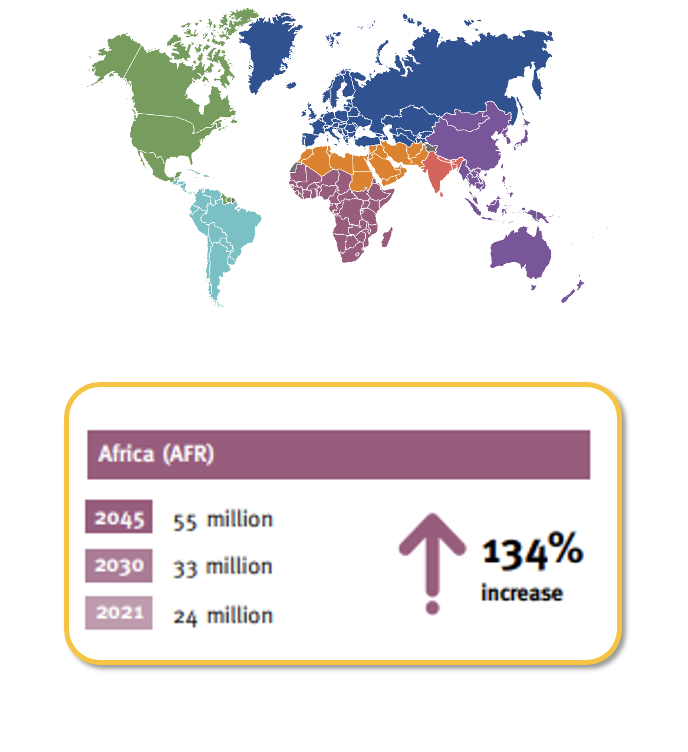
According to WHO, Africa tops the world in undiagnosed diabetes, with only 46% of diabetics in Africa are aware of the disease.
Lack of awareness is the biggest challenge in combating lifestyle diseases.
Many people are unaware of their health condition and only go to the hospital when their symptoms are their worst, when treatment is costly and when it may be too late for some.
This is the reason why we are focusing on raising awareness of lifestyle diseases by offering free health checkups, advice on lifestyle changes and connections to appropriate resources.
Key Facts: (from WHO)
- Noncommunicable diseases (NCDs) kill 41 million people each year, equivalent to 71% of all deaths globally.
- Each year, more than 15 million people die from a NCD between the ages of 30 and 69 years; 85% of these “premature” deaths occur in low- and middle-income countries.
- 77% of all NCD deaths are in low- and middle-income countries.
- Cardiovascular diseases account for most NCD deaths, or 17.9 million people annually, followed by cancers (9.3 million), respiratory diseases (4.1 million), and diabetes (1.5 million).
- These four groups of diseases account for over 80% of all premature NCD deaths.
- Tobacco use, physical inactivity, the harmful use of alcohol and unhealthy diets all increase the risk of dying from a NCD.
- Detection, screening and treatment of NCDs, as well as palliative care, are key components of the response to NCDs.
Lifestyle Diseases in Africa
Lifestyle diseases, sometimes referred to as chronic or non-communicable diseases, such as type II diabetes, hypertension and cardiovascular diseases are a social problem in Africa. They are often thought to be public health problems of significance only in high-income countries. Actually, only 20% of chronic disease deaths occur in high-income countries, while 80% occur in low- and middle-income countries (WHO, Preventing Chronic Diseases, 2005). The problem is that there is a lack of awareness; the undiagnosed cases are estimated to be as high as 60% to 80% in Cameroon, Ghana and Tanzania (WHO, Cardiovascular diseases in the African Region, 2005). Decades later, only 46% of diabetics in Africa are aware of the disease (WHO, 2022).
Governments in many African countries play the largest role in spreading awareness, prevention, management and treatment of these diseases. Insurance companies also play a key role. NPOs such as the WHO and the International Diabetes Federation are involved in the prevention and treatment of diabetes. Public and private healthcare providers play a role in raising awareness and provide treatment of non-communicable diseases. Food manufacturers provide the diet necessary to manage some of the diseases. Pharmaceutical companies provide the drugs used in treatment. Supply chains in the medical and food industry, private healthcare databases and markets are also some of the institutions involved in this social problem.
One outcome is to increase the awareness of these diseases. Another is to increase the number of people practicing prevention behaviours. The third outcome is to connect those at risk or already suffering to affordable service providers such as healthcare facilities, NPOs, healthy meal kit providers, etc. Eventually, the goal is to reduce the number of people dying from these diseases. Prevention and control of the diseases could save millions of lives per year.
In Africa, people develop disease at younger ages, suffer longer and die sooner than those in high-income countries. This undermines countries’ economic development as many of those affected are at the peak of their productive and economic activity. Reducing the number of people at risk will create tangible social value, in terms of economic value as well as saving human lives, ultimately improving the well-being of society.
Three Major Issues in Combating Lifestyle Diseases in Africa

1. Low Rate of Health Insurance Penetration
Due to high medical costs, many people do not get access to medical care even if their health deteriorates.

2. Lack of routine health checkups
Except for some corporate insurance welfare programs, there is a lack of routine health checkups.
3. Changes in eating habits and lifestyles
People now consume foods high in fat and carbohydrates, and daily lifestyles are shifting from manual labor to sedentary office work.
In addition, traditional diets are mainly carbohydrates, so even people from lower incomes are not consuming healthy diets.





 Afya Ngao Africa